 Pin this
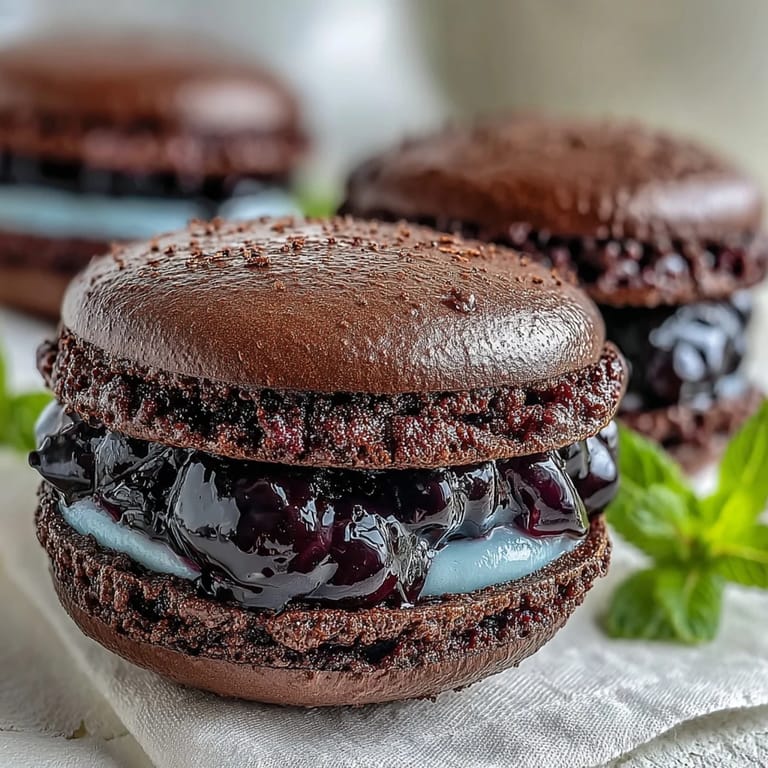
 The first time I attempted macarons, I was standing in my kitchen at midnight with flour everywhere and a determination that bordered on reckless. My friend had casually mentioned she'd never had a homemade macaron, and something in me thought, why not try? Black currant felt like the right choice—sophisticated, slightly tart, the kind of flavor that whispers rather than shouts. These delicate almond meringue shells with their jewel-toned ganache filling have since become my love letter to French patisserie, proving that beautiful things are worth the fuss.
I'll never forget the moment my sister bit into one and her eyes went wide—not from shock at the delicate crunch, but from the way the flavors unfolded. That's when I realized these weren't just cookies; they were little moments of joy I could hand to people I cared about. Baking them became less about proving I could and more about the ritual of creating something that made others pause and truly taste.
Ingredients
- Aged egg whites (120 g): Let them sit in the fridge for 24–48 hours before using; this isn't fussy, it's the secret to a stable meringue that won't collapse.
- Powdered sugar and almond flour (200 g and 120 g): Pulse them together finely in a food processor, then sift—this removes lumps that would ruin your smooth shells.
- Granulated sugar (100 g): Add it gradually to the whipping egg whites so each grain dissolves into glossy, stiff peaks.
- Blackcurrant purée (100 g): Strain it well to remove seeds, or use cassis purée if you can find it; the flavor is what transforms these shells into something memorable.
- White chocolate and butter (120 g and 30 g): The chocolate carries the fruit flavor while the butter adds silk and richness to the ganache.
- Lemon juice (1 tsp): Just a whisper of it brightens the blackcurrant without announcing itself.
- Salt and food coloring: A pinch of salt enhances the meringue's structure, and gel coloring gives you that stunning blackcurrant hue without adding moisture.
Tired of Takeout? 🥡
Get 10 meals you can make faster than delivery arrives. Seriously.
One email. No spam. Unsubscribe anytime.
Instructions
- Set up and prep your almond flour base:
- Line your baking sheets with parchment or silicone mats—this prevents sticking and makes the whole process smoother. Pulse your almond flour and powdered sugar together in a food processor until impossibly fine, then sift it into a bowl to catch any stubborn bits.
- Whip your egg whites into billowing clouds:
- In a grease-free bowl, beat the aged egg whites and salt until foamy, then add the granulated sugar gradually while beating until stiff, glossy peaks form. This is your foundation, and it needs to be strong and shiny.
- Tint and fold with intention:
- Add your gel coloring and fold it through gently. Now comes the meditative part: fold your dry ingredients into the meringue in three additions, using a rubber spatula in a slow, deliberate motion until the batter ribbons thickly and you can draw a figure-8 without it breaking.
- Pipe with patience:
- Fill a piping bag with a 1 cm round tip and pipe small circles about 3.5 cm across onto your prepared sheets, spacing them slightly apart. Tap the tray firmly on the counter several times to release air bubbles, then use a toothpick to pop any stragglers.
- Rest until they develop their skin:
- Let the shells sit at room temperature for 30–45 minutes—you'll notice a slight matte skin forming on top and they'll feel dry to the touch when ready.
- Bake with precision:
- Preheat to 150°C (300°F) and bake one tray at a time for 13–15 minutes, rotating halfway. They're ready when you can gently lift them off the parchment without sticking.
- Cool completely before touching:
- This is where patience pays off; rushing this step will cause your shells to crack.
- Make the blackcurrant ganache:
- Heat your blackcurrant purée until it just simmers, then pour it over finely chopped white chocolate and let it sit for a minute. Stir gently until smooth, then add the softened butter and lemon juice, stirring until fully incorporated.
- Cool the ganache until it's pipeable:
- Let it thicken slightly, but not so much that it becomes stiff; you want it to flow smoothly between the shells.
- Pair and pipe with care:
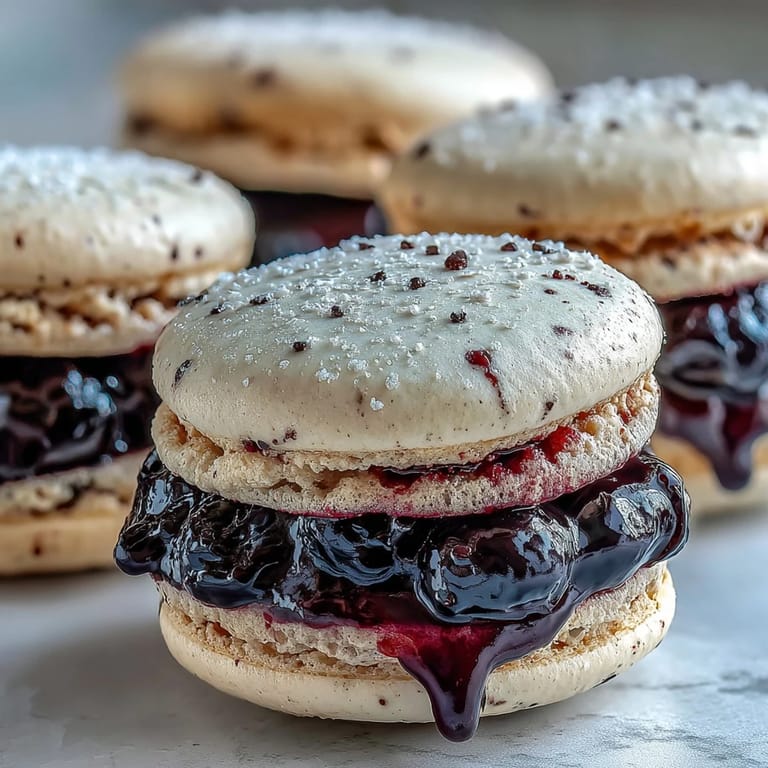
- Match your shells by size, pipe a small amount of ganache onto one shell, and sandwich gently with its partner. Press together so slightly that a little ganache peeks out at the edge.
- Rest and mature:
- Place them in an airtight container and refrigerate for at least 24 hours—this allows the shells to absorb moisture from the ganache and the flavors to develop their full complexity. Bring to room temperature before serving.
 Pin this
 There's a moment, usually around day two after assembly, when you bite into one of these and the shell gives way with that perfect crack, and the ganache is cool and silky on your tongue. That's the moment that makes every fussy step worth it. These little cookies stopped being a project and became something I make whenever I want to remind myself or someone else that beautiful, delicious things are possible.
The Truth About Macaron Technique
Macarons have a reputation for being temperamental, and honestly, they are—but not because they're complicated, they're just honest. They tell you immediately if your meringue wasn't right, if you overmixed, if your oven runs hot. This feedback loop is actually a gift once you embrace it. The first batch might not be perfect, and that's okay; each one teaches you something about your kitchen's particular quirks and your own instincts.
Why Blackcurrant Is the Perfect Flavor
Blackcurrant sits in this beautiful place between tart and sweet, between familiar and exotic. It's not aggressively fruity like strawberry, nor is it as straightforward as vanilla. The white chocolate ganache plays against its slight tartness, creating a balance that feels elegant but approachable. When you bite through that shell and hit the ganache, it's like the flavors are introducing themselves politely before becoming friends in your mouth.
Making Macarons Yours
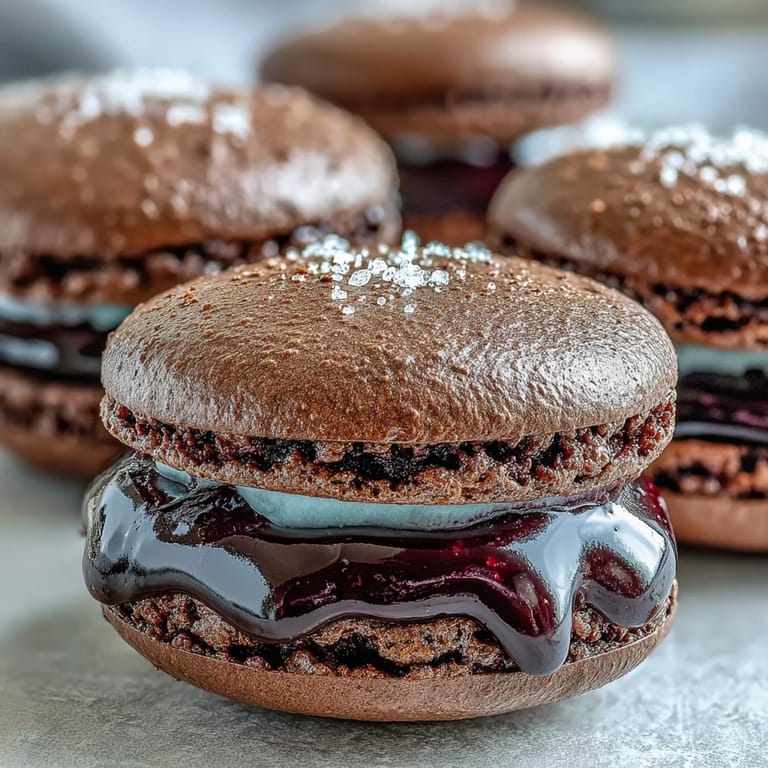
Once you've made these a few times and found your rhythm, you'll start to see them as a canvas. The almond shells are neutral enough to pair with nearly any flavor—imagine pistachio shells with rose ganache, or vanilla shells with lavender cream. The beauty of mastering this base recipe is that you've unlocked a technique that lets you create macarons that match the season, the occasion, or simply your mood.
- Try brushing the finished shells lightly with a mixture of blackcurrant liqueur and edible glitter for extra shine and a subtle boozy note.
- Store them in an airtight container in the fridge for up to five days; they actually taste better on day two when the flavors have melded.
- If you're making these for someone special, remember that homemade macarons carry a message that no store-bought version ever could.
 Pin this
 Making macarons feels like you're holding hands with French pastry tradition while creating something entirely your own. Take your time, trust the process, and know that each batch brings you closer to mastery.
Recipe Questions
- → Why must egg whites be aged before making macarons?
Aging egg whites for 24-48 hours in the refrigerator allows them to lose moisture and become more concentrated. This results in a more stable meringue that holds its volume better during folding and piping, leading to smoother shells with fewer cracks and better feet formation.
- → How do I know when macaron batter is properly mixed?
The batter should flow in thick ribbons from your spatula and slowly disappear back into itself when drizzled over the surface. You should be able to draw a figure-8 without the ribbon breaking. Overmixed batter will be too runny, while undermixed batter will hold stiff peaks and create lumpy shells.
- → Why do macarons need to rest before baking?
The resting period allows a skin to form on the surface of the shells. This skin is essential for proper rising in the oven—it traps steam inside, causing the macaron to rise upward and form the characteristic ruffled "feet" at the base. Without proper skin formation, shells may crack or remain flat.
- → Can I substitute fresh blackcurrants for purée?
Yes, blend fresh or frozen blackcurrants and strain thoroughly through a fine-mesh sieve to remove all seeds and pulp. You may need to cook the purée briefly to thicken it slightly if it's too thin. Alternatively, cassis purée makes an excellent substitute with similar flavor profile.
- → Why must macarons mature for 24 hours before serving?
This crucial resting period allows moisture from the ganache to soften the crisp shells slightly, creating the signature chewy interior contrast. The flavors also meld and deepen during this time. Fresh macarons can taste overly sweet and lack the complex balance that develops after maturation.
- → What causes hollow shells in macarons?
Hollow shells typically result from overmixed batter, oven temperature that's too high, or underbaking. Overmixing incorporates too much air, while high heat causes the interior to rise too fast and separate from the shell. Ensuring proper batter consistency and baking at 150°C (300°F) for the full time helps prevent hollows.